
黃鴻璽 Daniel Huang
In ancient times, as humans observed the world around them, they found that every creature excelled in its own way. As our ancestors' wisdom began to take shape, they would often imitate animals through physical movement, and through that process, reflect on their own strengths and limitations.
When they watched tigers, leopards, wolves, and lions, they first mimicked the claws, then turned their attention to the shoulder blades, and only eventually came to understand the role of the spine. When they observed a white crane spreading its wings before taking flight, they first moved their arms in imitation, then considered the shoulders and elbows, and finally discovered the chain connection between the waist and legs.
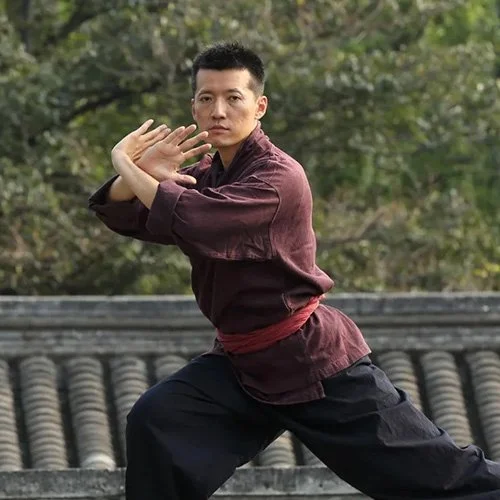
Examples like these are countless. Some martial arts styles absorbed these external forms as mental images, weaving them into movement — present, yet not always visible.
This is precisely the nature of Sifu Huang Weixiu's Praying Mantis.
As the name suggests, this is a form of image-based boxing. Its external shape draws from the mantis blade, while its internal intent travels through the whole body. Praying Mantis is an ancient art and a celebrated one — born in Yantai, Shandong, it stands as a beacon among the northern martial arts traditions. The system encompasses eighteen families of hand methods, drawing from the long fist of Taizǔ as its opening, and Hán Tong's Tongbei as its mother. Over hundreds of years it has continuously absorbed and refined. A living art should be exactly that.
I trained alongside Sifu Huang, and once traveled with him to Yantai. I witnessed him rise to practice in the dark of a winter morning, driven by his search for the Praying Mantis that lived in his mind. I watched him push hands with elder masters in a snow-covered square, tumbling forward and backward hundreds of times — all to experience firsthand a single moment of the Mantis fan che jin, the overturning-wheel force.
I reached out to Sifu Huang hoping he could carve out time from his busy schedule to teach a course through Yeben. Knowing that he had spent years refining his Praying Mantis, I asked whether he would be willing to open a class on the subject.
He gave a very “zen” reply: "Yes — and also no. When the mantis strikes, is it not also an expression of long fist and Taiji?"
I pressed further: if you were to teach a single course, with technique secondary and concept first, what would you choose?
He said: train fan che — that is training Praying Mantis.
Fan che is not a modern term. It is a traditional martial expression describing how force travels through the body in rolling, cascading segments — like a windmill catching the wind, or a waterwheel gathering the waves — generating power that flows without end. This is fan che. What matters in Praying Mantis is not the external shape of the mantis hand, but the internal quality of the mantis force.
As Sifu Huang put it: fan che is the Mantis strike.
Daniel Huang
Fly by Knight
上古時代,人類觀察萬物,總能發現動物各有所長。先輩智慧初開,常常通過肢體模仿,進而思考自身強弱。
看到虎豹狼獅,先模仿利爪,再思考肩胛,最後才理解是脊椎的運用;看到白鶴起飛前的振翅,也是先舞動雙手,進而想到肩肘,最後才發現是腰腿連環。
類似的例子,不勝枚舉,有些拳種,化外型為念想,放入動作中,若隱若現。
黃偉修老師的螳螂拳,就是這種樣子。
顧名思義,這是一套象形拳,外型取螳螂刀,內意走全身,螳螂是古拳,更是名拳,發源於山東煙台,是北方拳術的一盞明燈。螳螂拳包含十八家手法,從太祖的長拳起手,韓通的通背為母,百年來不斷吸收改進。拳是活的,本該如此。
我跟黃偉修老師一同修業,曾經跟隨他一起去過煙台,看過他為了找尋心中的螳螂拳,在天不亮的冬天早晨起床練功,在雪不化的廣場跟著老拳師搭手,前撲後跌數百次,只為了親身體驗一個螳螂翻車勁。
這次找到黃偉修老師,就是希望他能在百忙之中抽出一段時間來夜奔開課,我知道他多年來一直在完善自己的螳螂拳,所以我問他能否開一堂螳螂課?
他給了一個禪意的回應: 「可以,也不可以。螳螂出手,又何嘗不是長拳與太極的化身?」
我又問,那麼,如果開一趟課,動作次之,觀念為先,你會如何選擇?
他說:練「翻車」,就是練螳螂拳。
翻車不是現代語,而是武術傳統用語,讓身體的勁道,通過節節的滾動,像風車順風、水車捲浪一般,勁力綿延不絕,才是翻車。螳螂拳重要的不是外型那個螳螂手,而是內裡的螳螂勁。
就像黃偉修老師說的,翻車即是螳螂打!
黃鴻璽
夜奔文創